


Like pond filters, aquarium filters are vital life support systems for aquarium fish.
Without filters, and the beneficial bacteria inside them, we would not be able to keep fish as their tanks would pollute and they would poison themselves with their own waste. Filters come in all shapes and sizes and there is one to suit every tank size and budget. But which is the best aquarium filter?
Freshwater fish filter basics
Every filter needs to clear water and convert toxic ammonia into less harmful substances. Trapping waste is called mechanical filtration and converting waste using bacteria is called biological filtration. If you want to absorb something from the water or alter it, that’s called chemical filtration.
The best filters will combine mechanical, biological and chemical filtration, but simple foam filters can mechanically and biologically filter using just a sponge. You need small filters for small tanks and big filters for big tanks and big messy fish. The larger the filter output and media volume, the larger the tank it can filter and the more fish it can support.
Internal filters are the easiest
Internal filters go inside the tank and can be air powered by an air pump or water-powered by a powerhead. They are simple to use and install, small, so good for small tanks, and cheap to run. An air-powered sponge filter is necessary for tanks containing fish fry as they use very gentle filtration and sponge filters won’t suck up the baby fish. Sponge filter and air pumps are popular with shrimp tanks too.
Internal power filters create a jet of water and suck in more waste, and are the biggest selling type of filter. They are also known as canister filters.
Basic internal filters contain just one sponge, but the best ones have two sponges for alternate cleaning, space to put some chemical media like activated carbon, and even an extra, biological filter media section for separate bio-media like ceramics.
The icing on the canister fish tank filter cake is a venturi device, which blows tiny bubbles into the water at the same time that water is pumped, providing extra aeration. You then don't need an air pump.
Choose a small internal canister filter for a nano tank and the largest model for large aquariums, or double up and have one internal power filter at each end of the tank. You can alternate cleaning then too, to keep beneficial bacteria levels high, and enabling them to work properly.

Use external filters for large aquaria
External filters are large canister filters which sit inside the cabinet underneath the tank. They combine mechanical, biological and chemical media for all-round, powerful filtration. They are best for large tanks and large fish, but can also be doubled-up for extra-large or extra messy situations.
They are more complicated to set up than internal filters and have the potential to leak if installed incorrectly. But do it right and you’ll have no leak problems and peace of mind. Millions are used on fish tanks all over the world.
So which is the best aquarium filter for freshwater fish?
Just like cars, fish tank filters come in all shapes and sizes to do different jobs, in different applications. If you want cheap, small and simple, opt for an internal power filter. If you want dirt busting capabilities and strong water flow go for an external.
But as good as any new filter is, it's filter media is sterile when you buy it and will need to be matured with beneficial bacteria before being capable of supporting fish. Mature all new tanks, filters and biological filtration before adding fish, and test water for pH, ammonia, nitrite and nitrate. Always dechlorinate tap water.
While you're thinking about your aquarium filter, you might want to stock up on aquarium filter media. Why not try our brand-new pro filter media including Swell Aquarium Activated Carbon, Swell Aquarium Nitrate Remover Media, Swell Aquarium Phosphate Remover Media, Swell Aquarium Ultra Porous Biological Filter Media and Swell Aquarium Nitrate Remover Resin?
Aquarium filters are vital life support systems for aquarium fish. Without filters, and the beneficial bacteria inside them, we would not be able to keep fish.
Freshwater shrimp can be fun to keep and there are dozens of species and varieties available.
They stay small, eat algae, and some don’t even need a heater! They’re super easy to keep too.
Freshwater shrimp inhabit most of the world’s rivers, lakes and streams, but the ones we keep mostly come from Asia, like China, Taiwan, Japan, and Indonesia. Red cherry shrimp are the cheapest, stay small and they are good in unheated tanks as well as tropical ones.
Crystal red shrimp and their variants are the most colourful and sought after as many patterns can be line bred. Amano shrimp are the best algae eaters and were the first ornamental shrimp to be widely kept in aquaria, especially in planted aquariums. Sulawesi shrimp are super exotic but quite tricky to keep, coming from hard water, mineral-rich lakes.
Shrimp tank size
The best bit about keeping shrimp is how small they are, and their minimum tank size. Cherry shrimp and Crystal red shrimp are fine long term in nano tanks as small as 10 litres, meaning that everyone has room for a dedicated shrimp aquarium and set up and running costs are as small as can be. Amano shrimp are better in tanks of 20 litres or more, and of course, if you don’t combine them with large, predatory fish that will eat them, all shrimp can also be kept in community aquaria of any size.
Shrimp tank filtration
Freshwater aquarium shrimp produce very little waste so their tanks can be filtered by tiny filters, and with gentle flow. If you want to breed them, choose an air powered sponge filter which won’t suck up their young, and also enable the adults to graze the sponge for food particles. For adults, a small internal power filter will do, but some are more shrimp friendly than others, with fine mesh grills over the intakes. Shrimp-proof inlets for external filters are also available.
Like fish, shrimp don’t like ammonia or nitrite either, so always mature the filter with beneficial bacteria first, and always dechlorinate tap water before using it or use remineralised reverse osmosis water.
Heaters for shrimp aquariums
Cherry shrimp are fine at room temperature but for other shrimp, either choose a small, preset heater or a small, adjustable heater/thermostat. You’ll need one watt of heater per litre of water, so a 10 litre tank will only need a 10 watt heater. Use a thermometer to monitor temperature.
Lighting for shrimp tanks
Use a small LED light to enhance the shrimp colours. Many people combine shrimp with live plants, so if wanting to grow aquarium plants you’ll need a light that encourages plant growth. Set the light to come on for 8-10 hours per day.
Aquarium shrimp substrates
Shrimp are best over natural substrates like inert sand, gravel or aquatic soil. With soil also being the best for aquatic plants. Slope the substrate front to back to enable root growth.
Shrimp tank decor
Decor can range from stones to wood, to botanicals like leaves, which the shrimp-like to graze on. Make sure its inert, or lime-free.
Plants for shrimp
Plants can help the biology of an aquarium by taking up nutrients and producing oxygen. Shrimp also like to hide in them and graze them for algae and food particles. If you include live plants, fertilise them on a regular basis to keep them green, healthy and growing.

CO2 for shrimp tanks
Many shrimp keepers also inject CO2 to keep the plants super healthy. A small tank only needs a small CO2 kit, again helping to keep costs down.
Aquarium shrimp staple food
Shrimp graze on algae, detritus, biofilms and leaves, but when that’s all gone they need a food source in their own right. Feed shrimp specific diets to keep them in the best of health.
Freshwater shrimp accessories
Small shrimp need tiny catching nets, tiny syphons and tiny equipment. Match equipment to tank size and shrimp size to get the right tools for the right job.
Tankmates for freshwater shrimp
Fishy tank mates should be similarly tiny, so only combine shrimp with small tetras, micro rasboras or other nano fish like Scarlet badis or Pygmy rainbowfish. Don’t trust any fish over 3” as they may eat the shrimp, mistaking them for food.
Baby shrimp
Cherry and Crystal red shrimp breed easily, and shrimp keeping can be very addictive! Shrimp keepers often keep several nano tanks, or three in a line called a Triptych, with similar decor but different shrimp in each tank.
Freshwater shrimp can be fun to keep and there are dozens of species and varieties available. They stay small, eat algae, and some don’t even need a heater!
Carbon is a chemical filter media for aquariums which removes dyes, odours and impurities from the water.
It uses adsorption, meaning it can attract molecules to its surface where it will then adsorb and hold the impurities until saturated. When carbon is saturated, throw it away and replace with new.
Every aquarium is different and unlike phosphate remover, it’s hard to test the water to get an idea of when carbon is spent and no longer useful. So much more simply we just change carbon on a monthly basis.
Carbon can come in granular or pellet form, or even impregnated into filter pads. Activated carbon is exposed to higher temperatures during manufacturing, giving it a higher surface area. Activated carbon is more expensive but more porous and those tiny pores make it more effective. Loose aquarium activated carbon can be placed inside a mesh bag, inside aquarium filters.
Carbon is most commonly used to make aquarium water crystal clear, by removing tannins from bogwood and discolouration from fish food, fish faeces, organic compounds and biological processes, which can make water go yellow.
Carbon media can also be used for removing chlorine and heavy metals from tap water, and traces of medications from fish tanks. That’s why you should remove carbon when treating your fish for disease. It will soak up the medication and make it less effective.
Change filter carbon every month, in conjunction with a filter clean and a partial water change. Activated carbon products are suitable for use in all aquarium and ponds including coldwater, tropical and marine. The use of activated carbon will not affect beneficial bacteria, or cause an ammonia spike.
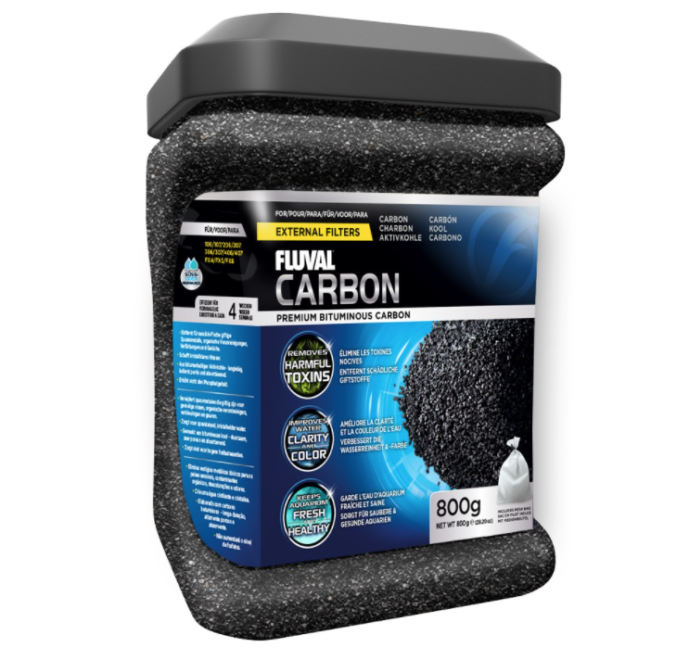
While you're thinking about your aquarium filter media, you might want to stock up. Why not try our brand-new pro filter media including Swell Aquarium Activated Carbon, Swell Aquarium Nitrate Remover Media, Swell Aquarium Phosphate Remover Media, Swell Aquarium Ultra Porous Biological Filter Media and Swell Aquarium Nitrate Remover Resin?
Carbon is a chemical filter media for aquariums which removes dyes, odours and impurities from the water. But how long does it last?
There is a maximum of 12 hours of daylight on the equator so that’s the maximum length of time that any aquarium containing tropical fish should be lit for. Any more will cause algae.
But it’s worth considering other factors that affect sunlight duration in nature. At dawn and dusk, the sun’s brightness is at its weakest so by utilizing controllable LED lighting you can simulate dawn and dusk cycles on your aquarium. Cloud cover can affect the sun’s intensity as can rainfall, and if your fish and plants come from forested areas they will no doubt experience shade from the forest canopy above.
Because of these factors live aquarium plants and corals can survive on as little as eight hours of light per day, and if you are experiencing algae issues the first thing to do is to set your lighting so that it doesn’t exceed eight hours per day.
For reef tanks, reefkeepers often set a gradual fade in and out of their lighting per day, but also start and end the day with blue lighting, ramping up to its whitest setting at midday to simulate bright midday sun in the tropics.
If your lighting isn’t controllable plug it into a simple light timer and set it to come and go off at the same time every day. If you don’t have live plants or corals, and just have tropical, coldwater or marine fish, you can even turn the lights off when you aren’t viewing the fish. They will be fine in ambient room light and you’ll get far less algae growth to remove as a result.
There is a maximum of 12 hours of daylight on the equator so that’s the maximum length of time that any aquarium containing tropical fish should be lit for.
Lots of our tropical fish naturally inhabit soft water in the wild, including Cardinal tetras, Angelfish, Discus, Rams, Clown loach and Pearl gourami.
And most of the fish species that come from the Amazon basin, peat swamps in South East Asia and rainforest streams in West Africa prefer it too. Soft water is water is which is low in calcium and magnesium.
Rainwater is soft water and water only becomes hard through percolating through and flowing over bedrock which contains calcium carbonate, magnesium, and lime, like limestone. Your tap water will either be hard or soft, and the way that you can tell is that hard water leaves white deposits around taps and in your kettle. You can also test whether your tap water is hard or soft using a General Hardness (GH) test kit.
If you have hard water and you want to make it soft for your fish tank, Reverse Osmosis is a process that strips tap water of its mineral content, and is the best way to produce your own soft water from hard tap water. A reverse osmosis unit connects to an outside tap or mains coldwater pipe feed and is the best way to produce soft water on tap at home.
It also removes nitrate, phosphate and chlorine, producing very pure base water to use in any freshwater or saltwater aquarium. Some RO units also utilize deionization, further purifying the water.
Once you move exclusively to use RO however the pH, GH and KH can drop dangerously low, so use a buffer, even if you want very soft water for Discus, to prevent the pH and KH from crashing.
Water softening pillows can be used to soften water and can be placed straight into the tank or ideally into a large filter with water flowing through it or over it. They work in different ways from the use of peat moss to deionising resins, but they are not as effective as actually stripping the minerals at source from the tap water by use of a reverse osmosis unit. If you do a water change with hard water, the resultant bounce in GH levels are not good for the fish.
Can I use a water softener or a water filter?
Many domestic tap water softeners use salt (sodium ions,) to soften tap water for drinking, so that's not suitable for freshwater aquarium fish species. Depending on the type of water filter or filter jug, it many not actually lower General hardness or carbonate hardness, so test the tap water for GH and KH using aquarium test kits before and after.
It could work out expensive too when you consider how much water you use each week for fish tank water changes. Best is to use aquarium water softener solutions that are purpose made for the job.
Can you use distilled water to soften aquarium water?
Distilled water is water that has been evaporated and then condensed, leaving behind its dissolved minerals. It should have a general hardness and carbonate hardness of zero, but it is not cheap to buy per volume and minerals would need to added before aquarium use. It should not be used for a fish tank in its raw form.

Lots of our aquarium fish naturally inhabit soft water in the wild, including Cardinal tetras, Angelfish, Discus, Rams, Clown loach and Pearl gourami.
Few freshwater aquariums look more stunning than a planted tank.
But its the first few steps of setting it up that can make the difference between an average looking scape and a jaw-dropping Nature Aquarium.
Start at the bottom by placing a deep layer of aquatic soil on the base of the tank. Aquascaping soil is soft for roots to bury into, holds nutrients to fertilise plant species and holds rocks and wood in place easily. There is no need to pre-wash soil so pour it straight onto the tank base and bank it up, front to back, so its about an inch deep at the front of the tank and anything up to six inches deep at the back. Use your hand, a dry paintbrush or a gravel rake to smooth the soil surface.
Wood is next, so choose, large, appealing pieces that look natural, without squared off or sawn corners. Be brave with your wood choice and choose one or two pieces of the same type of wood, laying them diagonally with the fat end in the soil and the thin, branching ends pointing up towards the water surface. Wood can be placed in planted tanks so that it sticks out of the water, for added, natural effect.
Once the wood is in place choose one type of rock and place chunks of it around the base of the wood. Place the largest pieces next to the trunk and radiate smaller pieces outwards from that. Rocks can be broken up with a hammer and small fragments scattered around the outward faces of the rocks.
Fill the tank with tap water to a depth that just covers the soil, as it makes it easier to plant into. Prepare potted and tissue cultured aquarium plants by removing any growing medium from the roots, and teasing them into small, 5cm sized bunches, ready for planting. Using tweezers, plant each clump of plants into the soil, placing tall species at the back and small, carpeting species at the front. Cryptocoryne look particularly effective when placed in the crevices in and around rocks and wood.
Tie Java Fern, Anubias and mosses to the wood using fishing line before filling the aquarium. Dechlorinate, add a complete fertiliser, then fit a CO2 diffuser in an area of strong circulation and a drop checker (to indicate CO2 levels,) at the other end of the tank. Fit external filter pipework, plug in heater, switch them on and set the light to come on for a fixed eight-hour photoperiod every day.
About a week later introduce the first algae grazers like Otocinclus catfish and Algae eating Japonica shrimp, Caridina multidentata. Change the water regularly, fertilise on a daily basis and wait for your underwater garden to grow.
Few freshwater aquariums look more stunning than a planted tank. But its the first few steps of setting it up that can make the difference.
Set up a tropical tank and sooner or later you’ll want some cleaners. The tank light will cause the glass and decor to go green and detritus (fish poo and uneaten food,) will start to build up in the gravel. But are there really fish that will clean your tank for you or is it a myth?
There are thousands of fish species available and some of them do indeed graze on green algae as well as other foodstuffs. Suckermouthed catfish like Common and Sailfin Plecos, Bristlenose and Otocinclus all graze algae and will “clean” the tank of it, but they do also need food in their own right if they are to grow, stay healthy and thrive.
Depending on the type of algae, other grazers can also be utilised from Siamese Flying Fox to Mollies, Chinese Algae Eaters to Algae Eating Shrimp. Some algae aren’t algae however like slime algae, which is actually a bacteria. No fish or invertebrate will graze on and clean the tank of slime algae, so other means including regular gravel vacuuming, increased water changes and increased water circulation should be used to tackle those.
Algae eating fish come in all shapes and sizes and there is a species to suit all types and sizes of tropical fish tank. But don’t expect them to clean all the algae for you (that’s your job,) and always offer other, appropriate foods for them to graze on.

Which fish clean the gravel?
Separate from algae eating fish are substrate sifters like whiskered Corydoras catfish - well behaved, small communal catfish which are perfect for tropical fish tanks. Tanks that contain Corydoras catfish do tend to have cleaner substrates than those that don’t, but their cleaning action is more via their search for edible morsels in the gravel which in turn dislodge dirt particles and the filter then remove them.
Dirty substrates are actually dangerous for fish like catfish and loaches as they can harbour bacteria which may erode their delicate barbels, infecting the fish and hindering their ability to find food. So conversely these substrate “cleaners” actually need a clean substrate, again should be fed species-specific sinking foods, and are not a substitute for regular gravel vacuuming to be carried out by the owner.
While you're thinking about your fish, you might want to stock up on tropical fish food. Why not try our brand-new tropical fish food including Swell Tropical Fish Flakes, Swell Tropical Colour Enhancing Flakes, Swell Tropical Colour Enhancing Granules, Swell Tropical Spirulina Flakes, Swell Tropical Cichlid Junior Granules, Swell Tropical Cichlid Granules, Swell Tropical Garlic Flakes, Swell Tropical Sinking Tablets, Swell Tropical Sinking Pleco Tablets, Swell Tropical Betta Diet, Swell Tropical Shrimp Diet and Swell Tropical Holiday Diet.
Set up a tropical tank and sooner or later you’ll want some cleaners. The tank light will cause the glass and decor to go green and detritus will start to build up in the gravel.
The oceans are unrivalled in their size and stability, and the corals we keep have evolved to that very, clean, pure, stable environment.
In a closed saltwater aquarium we may start off with good saltwater but it quickly depletes and degrades its chemical values. Pollutants build up too, so we need to change the aquarium water.
Water changes are vital to the success of most reef aquariums. They dilute nitrates and phosphates in saltwater aquariums, flush away metabolites and hormones, and if carried out in conjunction with a filter sock clean or a gravel vacuum, of the sand bed they take solid waste with them too.
But the water you replace brings vital trace elements and buffers and helps to reset the captive marine saltwater aquarium environment so that it's more like the tropical oceans again. Clean, pristine, low in nutrients, but high in elements.
So as long as the temperature and salinity of the salt mix water change water is spot on, there is no limit to how often you change the water in a reef aquarium, and how much you change each time. In fact, regular water changes will only benefit your reef tank and the more you do them, the lower phosphates and nitrates will be, and the more constant KH, Calcium and Magnesium will be. And stability is key.
Change the tank water every day and you wouldn’t even need supplemental chemical dosing, and some public aquaria with access to natural seawater nearby do exactly that - constantly replacing water in the display tank with fresh seawater.
But the average home reefkeeper doesn’t have the time or the budget to change water every day, so there are two ways to do it. The first way is to change 10% of the reef tanks water weekly. This will be enough to replace trace elements in most reefs and will keep most parameters in check. But it won’t be enough to buffer KH, Calcium and Magnesium in reefs with growing corals and additional buffering will still need to be carried out.
The second method is to use test kits to monitor the water and to give you an indication of when to change the water, and how much. Nitrate is a biproduct of biological filtration and needs to be kept below 10ppm. Test nitrate regularly and work out how many water changes, and how much each time you need to do to keep the nitrate level in the tank at or below 10ppm.
If the nitrate level continues to climb, you need to change more water. If the level remains constant you are changing enough, and if the level steadily declines, you are changing more than you need to. But as stated previously, all water changes are good, and you can’t really change too much. As long as the saltwater you are putting in is made up from a reef recipe salt mix, and the salinity, or specific gravity, is at 1.025s.g. Test this using an accurate refractometer.
What is Triton Method?
Triton Method uses accurate analysis to monitor some 30 water chemistry parameters and tell if they are too high, too low, or just right. With Triton, instead of changing water to remedy a broad spectrum of issues they target specific elements and offer those individually to be dosed and topped back up to the correct level without having to do a water change. So some Triton Method reef aquariums go years without changing water because the water is “changed” one element at a time, and if other levels are ok, there is no point in literally flushing them away, just to pay to replace them.
But as a general rule, change at least 10% of your reef aquariums total volume per week to help keep everything in check.

The oceans are unrivalled in their size and stability, and the corals we keep have evolved to that very, clean, pure, stable environment.
Bubble algae is a bottle green coloured single-celled algae which forms jelly bean or round, marble-like shapes in the marine aquarium.
It often starts at the base of corals but can plague if uncontrolled, blocking pumps, weir intake slots and overgrowing corals.
Large growths can be removed by hand but there is one specific critter that reefkeepers use to deal with it. The Emerald Crab, Mithrax sculptus, grows to 2” across and comes from the Caribbean. Like most crabs, it is omnivorous but will also graze algae and importantly, Valonia spp. Bubble Algae.
Look closely and the Emerald crab has spoon-shaped pincers which it uses to grab, pierce and tear the bubbles. They are largely reef safe and the only animal prescribed to deal with Bubble Algae. They are suitable for nano reefs and large reef tanks and for bad manifestations add three or more. Sometimes also available in a reddish colour.
Some reefkeepers also report success with the Foxface Rabbitfish, Siganus vulpinus, although they need a large aquarium, in excess of 400 litres volume.
Bubble algae is a bottle green single-celled algae which forms jelly bean or round, marble-like shapes in the marine aquarium.