403 Forbidden
ERR_WEB_NGX_403

Rated EXCELLENT on

Platinum Trusted Service, based on over 42,000 reviews.

Herons are the most prolific killer of pond fish in the UK, but many ponds are threatened by other creatures too.
In this guide, we’ll cover the most effective ways to protect your pond fish from common predators.

A thriving pond full of vibrant fish is a beautiful feature in any garden, which makes it very frustrating when predators threaten your fish.
Herons, cats, foxes, and other predators are clever, persistent, and often hard to stop before it's too late. If you've ever noticed your fish are missing or your pond has been disturbed, you're not alone. However, it is possible to scare these pests away with deterrents.
Different types of deterrents are available to suit a wide range of ponds and scare off a range of predators, but which one should you choose?
The most prolific pond fish killer in the UK is the heron. They're attracted to shallow and clear water where fish are easy to see and reach. Herons tend to return to locations where they have found a reliable food source, which can often be garden fish ponds. Koi and goldfish are the most at risk, but even a wildlife pond can attract predators.
Cats and foxes are also known for preying on pond life. If your pond is easily accessible from the edges, or doesn't have any cover for fish to hide, these predators are likely to attack any fish you may have in your pond.
There are many different solutions to deter herons and other predators. These products all have different levels of effectiveness, although it can be a little challenging to know what works without trial and error first.

The most simple way to prevent birds and cats from accessing your pond is to block access to it. Physical barriers can be discreet, providing high levels of coverage for maximum safety.
Pond nets are the most common solution, albeit not the most visually appealing. These nets are very effective when fitted securely, preventing birds from reaching into the water. An added benefit of nets are that they keep your pond free from leaves and other debris during autumn. There are even some very low-profile nets available that are easier to see through and are simple to remove when required.
Recommended for: smaller ponds where protection is more important than visual appearance, such as a pond with expensive fish.
Pros:
Cons:
Check out our range of pond cover nets to protect your pond today.

These discreet and effective devices emit a mild, low-voltage pulse along the wire that can be situated around the edge of the pond. When an animal touches the wire, it receives a small shock that won't harm them, but will discourage them from returning. These units are very useful for deterring herons as well as cats and foxes, and are more suitable for a range of pond sizes.
Recommended for: medium to large ponds where nets are not suitable or desired for aesthetic reasons, or due to plants or a fountain.
Pros:
Cons:
Interested in discreet protection from cats and herons? Try the Velda Pond Protector today.

For a simple and sometimes non-electric solution that won't take away from the visuals of your pond, try some visual and motion activated deterrents, perfect to protect your fish from herons.
Reflective deterrents reflect or scatter sunlight to disrupt herons and even mimic movement. On sunny days, these decorative pieces are at their most effective for protecting your pond, and tend to be relatively inexpensive. They also can be styled as a decoration in your pond, keeping the visual impact on your garden low. They are quick and easy to install, and can be used alongside other deterrents for higher levels of protection.
Recommended for: small to medium ponds situated in open, sunny locations
Pros:
Cons:
Recommended products:

Herons are solitary feeders, avoiding fishing in areas when another bird is present. This makes decoy herons an excellent choice to scare these birds away. When placed by your pond they mimic a territorial bird already occupying the space, which reduces the likelihood a real heron will feed from your pond.
Decoys are simple, low-effort statues that blend into your garden, perfect for those seeking a low visual impact. These statues are known to be most effective when regularly repositioned and used alongside other methods.
Recommended for: small to medium ponds, used alongside other methods of deterring herons.
Pros:
Cons:
Shop our Swell Decoy Heron now, the perfect natural defence to scare away herons with ease.

Wire and bell deterrents can be assembled surrounding your pond, making a simple barrier with stakes and near invisible wire. Small bells attach to the wire and jingle when disturbed, startling many different predators as they approach your pond. This setup almost acts as a physical barrier, but allows for easy viewing and access to your pond whilst protecting your fish.
Recommended for: small to medium ponds in quiet gardens
Pros:
Cons:
Try the Velda Heron Stop to protect your pond today, protecting ponds with a circumference of up to 12.5m in size.

Motion activated units utilise sensors to detect any movement around your pond, triggering a response. They typically use lights, sounds, or a combination of both to startle predators, including herons. These systems are highly effective and react only when required, making them energy efficient, and less intrusive. Some even mimic natural predator sounds such as bird-of-prey calls.
Recommended for: medium-large ponds in open areas that require persistent deterrence.
Pros:
Cons:
Check out the Velda Laser Guard to protect your pond fish from a range of predators for a long time to come.

Choosing the best method for you depends on the size of your pond, location, and which predators you're dealing with. You may even want to choose multiple devices to maximise effectiveness.
| Pond Type | Recommended Solution |
| Small ponds with high fish stock | Cover net |
| Small-medium ponds in low-predator areas | Decoy heron |
| Small-medium ponds in sunny, open areas | Reflective décor |
| Medium ponds | Wires and bells |
| Medium-large ponds with regular predator visits | Electric fence |
| Medium-large ponds in high risk locations | Motion activated devices |
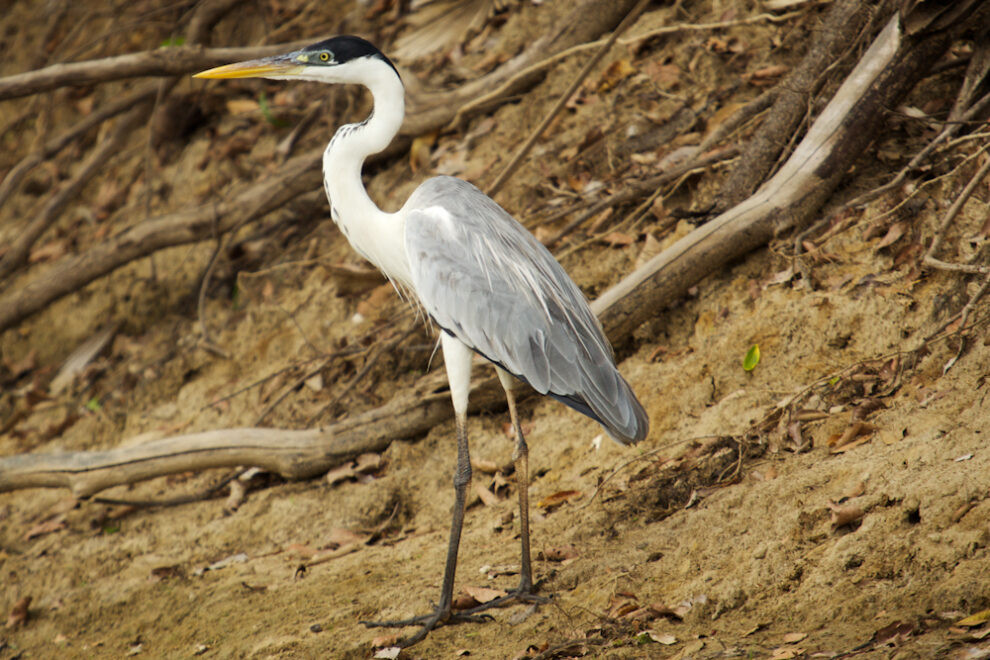
Ponds with goldfish and Koi are more attractive to herons and require more protection. Alongside one of the methods we've covered, it's also recommended to add underwater shelters to provide safe hiding spaces for your fish, reducing their visibility from above and adding an extra layer of defence.
While there is no single deterrent that works for everyone, often it's best to combine solutions and vary the positionings of them. Methods that work in some ponds may not work in others, so a little trial and error is needed. If you're struggling to choose, consider the location of your pond and the type of wildlife it attracts, and how visible it is from above. Even small changes like increasing coverage of plants can make a huge difference.
Explore our full range of heron deterring devices here.


Decoy herons are a waste of money. A heron flying over sees what it believes is another heron and thinks "Ooh look, a heron. There must be food there"
What has worked for me is growing a tree over the pond. Yes, the blossom and leaves are a massive pain but preferable to having the fish eaten.
I also have a jacuzzi-like pond surface due to 2x60lpm air pumps. Vertical pond sides make it harder for a heron to wade in.
Oh and a sign that says "No Herons"
I to have had a visit ,trap them !but you must destroy them as they are a invasive species
Or they will kill something else like more fish or water voles